
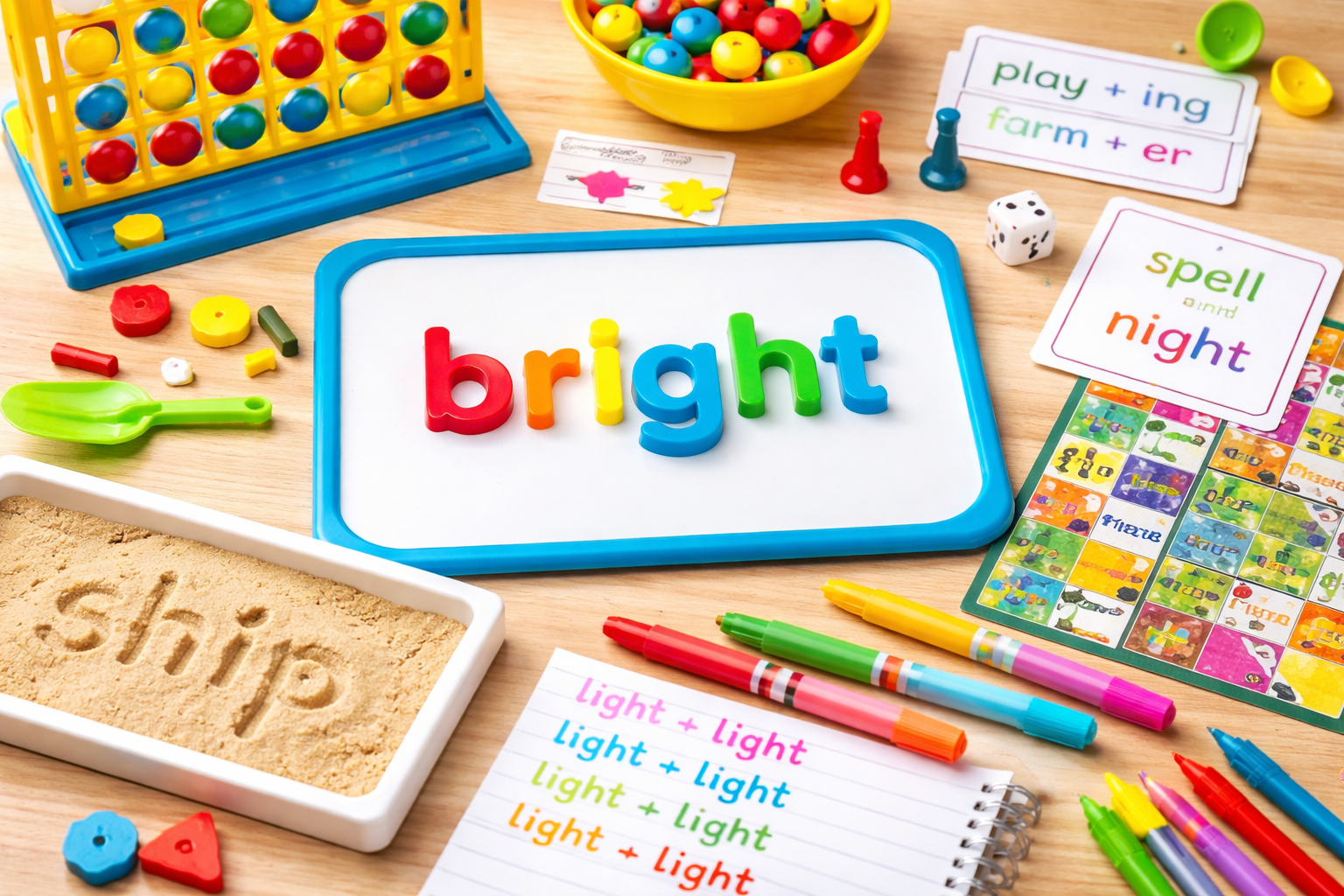
How to Help Your Child with Spelling at Home: Multisensory Strategies and Games
Strategies to Help Your Child with Spelling at Home
Spelling can be difficult for many children, particularly if they find reading and writing hard work or struggle to remember letter patterns. For some children, learning to spell feels much harder than it seems to for others, even when they are trying their best. This can be frustrating for both children and parents.
The good news is that there are lots of simple, effective ways to support spelling at home. Spelling practice does not need to mean pages of copying words out. In fact, children often make better progress when learning is short, practical, and enjoyable.
Using multisensory spelling strategies and simple spelling games can help children feel more confident and engaged. Many of the best activities use things you already have at home, including everyday toys and family board games.
Why some children find spelling difficult
Spelling is a complex skill. It involves hearing sounds in words, remembering letter patterns, understanding rules, and storing words in memory so they can be recalled quickly. Some children find one or more of these areas difficult, which can make spelling feel confusing and tiring.
They may:
- forget spellings from one day to the next
- miss out sounds or letters
- reverse letters or put them in the wrong order
- struggle to hear all the sounds in a word
- find it hard to remember common exception words
- become upset or avoid writing tasks altogether
When this happens, it is important to keep practice supportive and manageable.
Keep spelling practice short and positive
Children usually benefit more from little and often practice than from long spelling sessions. Just five or ten minutes a few times a week can be enough.
Try to:
- focus on 3 to 5 words at a time
- revisit the same words regularly
- praise effort and perseverance
- stop before your child becomes tired or frustrated
- keep the tone light and encouraging
Confidence plays a big part in learning. If spelling starts to feel stressful, children are much less likely to want to engage with it.
Use multisensory spelling strategies
One of the most effective ways to support spelling is to make learning multisensory. This means helping your child to see, hear, say, touch and move while learning a word. Using several senses at once can make spellings more memorable.
Here are some simple multisensory spelling ideas to try at home.
1. Say it, tap it, write it
Say the word aloud together, tap or clap the syllables, then write it down.
For example, with the word remember, your child could say it slowly, clap the beats, and then write it. This helps children hear the structure of the word before trying to spell it.
2. Write words in sand, salt or shaving foam
Writing words in a textured surface can be much more memorable than writing them only on paper because you are using a variety of senses - including touch. You could use:
- sand
- salt
- flour
- shaving foam
- finger paint
This is especially helpful for children who learn well through touch and movement.
3. Air writing
Ask your child to write the word in the air using large arm movements while saying the letters aloud. Big movements can help some children remember letter sequences more easily.
4. Rainbow writing
Write the same word several times using different coloured pens or pencils, or trace over the same word in different colours. This can help children focus on the shape and pattern of the word.
5. Use magnetic letters or letter tiles
Magnetic letters on the fridge or letter tiles on the table can help children build words without the added challenge of handwriting. You can say a word and ask them to make it, then mix the letters up and try again.
6. Spot the tricky part
Many words have one part that is harder to remember. Highlight that section using a different colour or by drawing attention to it.
For example:
- said
- because
- people
- friend
You can even make up a silly phrase or memory trick to help.
7. Break words into chunks
Longer words can feel easier when broken into smaller parts, such as:
- play + ing
- help + ful
- farm + er
- re + turn
This helps children notice patterns and spelling rules.
Help your child notice spelling patterns
Spelling becomes easier when children start to see that many words follow patterns. Rather than learning every word as something completely new, they begin to make links between words.
You can help your child notice:
- words with the same ending, such as -ing, -ed, -ly, -tion
- words from the same family, such as help, helpful, helper
- common letter patterns, such as igh, ai, oa
- rules for adding suffixes
- when letters double in words
Talking about patterns helps spelling feel more logical and less random.
Make spelling part of everyday life
Spelling practice does not have to happen only at the table. Small moments during the day can be really useful.
You could:
- write a shopping list together
- ask your child to help write cards or notes
- spot target words in books or magazines
- look for words on signs when you are out
- use fridge magnets to make words while cooking
- play quick word games in the car
These small, low-pressure moments can help reinforce learning in a natural way.
Spelling games to play at home
Games can make a huge difference, especially for children who are reluctant to practise spelling. The good news is that you do not need specialist resources. Many games families already own can be adapted for spelling practice.
Connect 4 spelling game
Connect 4 is easy to turn into a spelling game. Before your child drops in a counter, they need to complete a spelling task.
For example, they could:
- spell one of their target words correctly
- spell a word with a particular sound, such as ee or igh
- read a word aloud and then spell it from memory
- say another word in the same word family
Because the turns are quick, it keeps the game moving and makes practice feel manageable.
Snakes and Ladders spelling game
With Snakes and Ladders, each time your child lands on a square they complete a spelling challenge before their turn ends.
You could ask them to:
- spell a word from this week’s list
- say a word with the same suffix
- find the tricky part in a word
- use a spelling word in a sentence
- spell a word after looking at it for five seconds
This is a lovely way to add variety to practice without it feeling repetitive.
Hangman
Hangman can help children think about letter choices, word structure and common spelling patterns. Keep the words achievable so that the game stays fun and confidence-building.
Matching pairs
Make simple matching cards using:
- word and picture pairs
- root words and suffixes
- correctly spelled and incorrectly spelled versions of the same word
Children turn over two cards at a time and try to find a match.
Roll and spell
Use a dice and give each number a spelling action:
- say the word
- clap the syllables
- spell it aloud
- write it down
- use it in a sentence
- spell it again from memory
This works well because it adds an element of chance and variety.
Word hunts
Hide words around the house or garden and ask your child to find them, read them and then spell them. This is ideal for children who enjoy movement and need a more active approach.
Adapt any simple board game
Almost any board game can become a spelling game. Before taking a turn, your child can:
- spell a target word
- read a word card
- identify a suffix
- think of another word with the same pattern
This works well with games your child already enjoys, which often helps reduce resistance.
Encourage progress, not perfection
Children who find spelling difficult often need lots of repetition and reassurance. It is important for them to feel that improvement matters, even if they are not getting every word right straight away.
Try to notice and praise:
- good effort
- careful listening
- spotting patterns
- remembering part of a word
- trying again after making a mistake
A positive approach can make a big difference to confidence and motivation.
When to seek further advice
Some children need a little extra practice with spelling. Others continue to struggle despite regular support at home and in school. If your child finds spelling much harder than expected for their age, it may be helpful to look more closely at the reasons why.
This may be worth exploring further if your child:
- has persistent difficulties with reading and spelling
- finds it hard to hear sounds in words
- avoids writing tasks
- struggles to remember common words
- becomes very anxious about literacy
Understanding the underlying difficulty can help ensure that the right support is put in place.
Final thoughts
Supporting spelling at home does not need to be stressful. In fact, the most effective practice is often short, playful and practical. Multisensory activities, pattern spotting and simple family games can all help children become more confident with spelling over time.
By keeping practice positive and manageable, parents can make a real difference.